- Second Act Creator
- Posts
- Building a Resilient Brain: Multimedia Edition
Building a Resilient Brain: Multimedia Edition
A multimedia guide to training your brain today for strength, clarity, and resilience tomorrow.

Kevin Luten
January 18, 2026
Welcome to the 57th edition of the Second Act Creator newsletter—outlining the Gen X blueprint to flourish in midlife.
Not yet a subscriber? Welcome! Subscribe free.
Hello and welcome back to Second Act Creator. 🎉🎉
Across 48 of these letters in 2025, I explored varied nooks and crannies of science-backed concepts from psychology and health that I hoped might be helpful to Gen X readers like you. These letters were often long, sometimes stretching over several editions. I imagine this depth (aka, how long it took to read the dern things) was helpful at times and a curse at others.
A could use your advice:
I am thinking of trying two things over the first part of 2026. If you are willing, I need your advice on how these could improve the value you get from these letters:
Using multimedia formats (text, video, visuals) to convey complex ideas in less time. A first example is below (today’s letter). What other changes like this would help you learn and remember new ideas?
Using more action-oriented frameworks to build a better bridge between ideas and implementation. Would the addition of “cool ideas, but how do I use them?” be valuable to you? Any other advice along these lines?
Helping me with your advice is simple: Just reply to this email. This would help me a lot.
OK… let’s get into it!
OK, here’s what I have for you today:
One big thing. A guide to building a resilient brain as we age—in video, written, and visual formats.
You have to check this out. Why and how multimedia learning works.
Let’s jump in! 🦘

1️⃣ ONE BIG THING
Building a resilient brain: multimedia edition
This edition is a little different. For the first time, I’ve turned a full Second Act Creator series into a short, multimedia video—designed to make the ideas easier to grasp, easier to remember, and easier to share.
There are text-based and visual versions of these ideas below the video.
The video brings together the core ideas from my four recent letters on brain health, neuroplasticity, and cognitive resilience. Some people think best by reading. Others by watching or listening. This is an experiment in offering another way in—one that may help the concepts land more clearly, stick longer, or travel further when you want to pass them along.
Below the video, you’ll also find links to the four original newsletters, so you can move between formats depending on how you prefer to learn, or save and revisit the ideas from a different angle.
Building a resilient brain—video explainer:
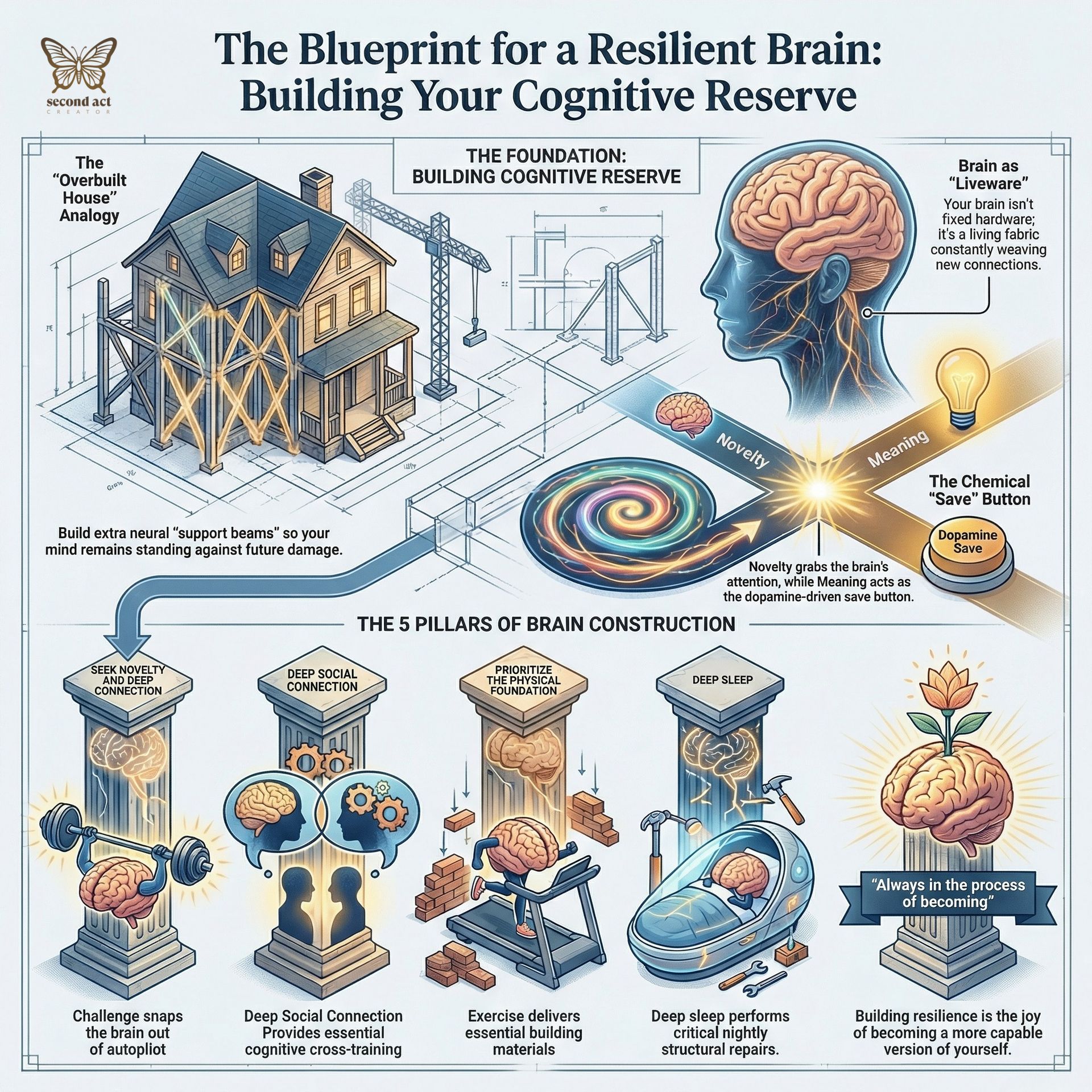
Building a resilient brain—written :
Your Livewired Brain - The brain isn’t fixed—it’s “livewired.” Experience sculpts both its structure and function, creating a system built to adapt throughout life.
Investing in Your Cognitive Reserves - Some brains stay sharp despite damage because lifelong learning, language, and social engagement build redundant neural networks that protect function.
Building a Brain That Ages Well - Novelty, meaning, and connection strengthen and integrate new circuits, forming a resilient network that supports cognitive reserve and healthy aging.
The Gen X Guide to Building a Resilient Brain – As we move into midlife and beyond, intentional habits become the infrastructure of cognitive resilience, helping you stay sharp, adaptable, and capable in the years ahead.
Building a resilient brain—visual explainer:
Building a Resilient Brain in Midlife
🔗 YOU HAVE TO CHECK THIS OUT
How Multimedia Learning Works
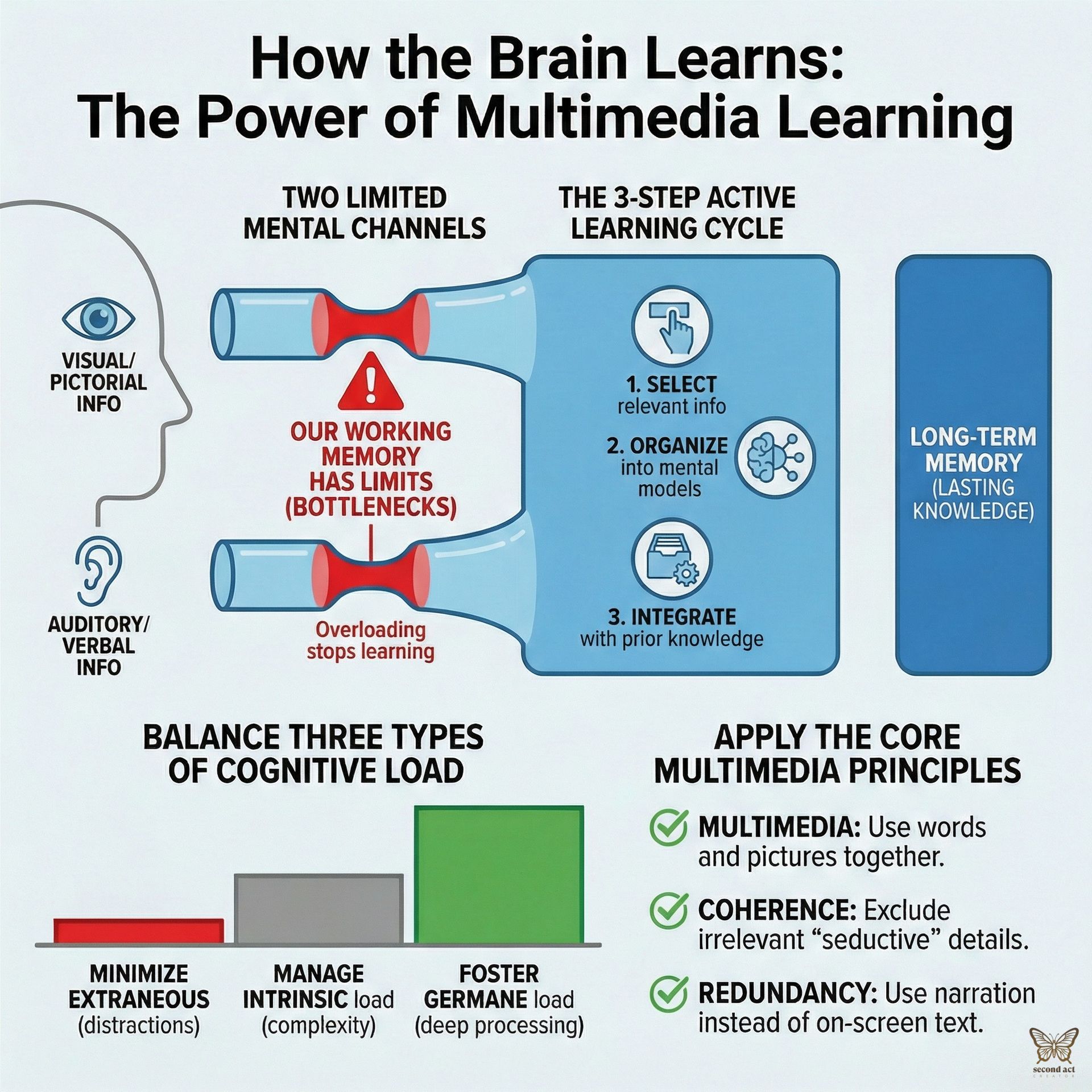
Decades of cognitive science research show that people learn and remember more effectively when ideas are presented through a combination of words, visuals, and audio rather than through text alone. This body of work is often referred to as multimedia learning research and is grounded in how the brain processes information.
Humans use partially independent systems to process verbal information (spoken or written language) and visual information (images, diagrams, motion). When these systems are engaged together, learning tends to be deeper and more durable. Well-designed multimedia content helps learners build clearer mental models, integrate new ideas with existing knowledge, and retrieve information more easily later.
Research also shows that multimedia learning is most effective when it reduces cognitive overload rather than adding noise. Clear structure, purposeful visuals, and aligned narration support understanding, while unnecessary decoration or distraction can interfere with learning. When done well, combining reading, watching, and listening improves comprehension, transfer of knowledge to new contexts, and long-term recall.
In practical terms, presenting the same core ideas in multiple formats gives the brain more “handles” to grasp and remember them—making learning not just faster, but stickier.
Go Deeper: Richard E. Mayer (2020). Multimedia Learning.
Multimedia Learning
Thanks for reading this week.
Have a great week.
Kevin
P.S. If you like this newsletter and want to support it, forward it to a friend with an invitation to subscribe right here: news.secondactcreator.com/subscribe.


Kevin Luten, Second Act Creator